
A Royal Artisan Legacy from the Qing Dynasty
Originating in 1882 in Wenzhou, the Zhejiang-based intangible cultural heritage bamboo marquetry was once elevated to the heights of the Forbidden City, gracing the imperial interiors of the Qianlong Emperor's reign. For over 240 years, the rosewood doors and windows of the Juanqin Zhai (a lavishly decorated pavilion located in the Forbidden City, built by the Qianlong Emperor as his intended retirement residence), adorned with intricate bamboo marquetry design, have defied decay and pests—a powerful witness to the durability and enduring legacy of this bamboo art.


Inlayed into Beams of Light
Step into the quiet dialogue of bamboo, light, and craftsmanship.
This is the art of Bamboo Marquetry, transforming bamboo into thousands of fine threads. From the imperial workshops of the Qing Dynasty, this discipline arrives in the present, reincarnated within this frame.
Each filament, calibrated in density and depth, weaves a vision as precise as silk. Daylight, in its transit, writes the narrative of hours in shifting silhouettes—a palimpsest of forms, an enduring poetry.
An Art of Patience, in Miniature
The creation of bamboo marquetry requires absolute patience. Artisans begin by using long, smooth bamboo strands as warp and weft to form an even and clean base grid. Then, with tweezers, they inlay shorter bamboo threads one by one, building the pattern piece by piece. A palm-sized decorative panel often requires the assembly of thousands of bamboo strands. The final piece showcases a unique texture: one side is glossy and smooth, the other retains an unadorned simplicity. This flawless integration fully manifests the beauty of meticulous craftsmanship.
1.Bamboo Selection
The process begins with the choice of superior long-node bamboo, prized for its long internodes and dense, fine grains. Only 4 to 6-year-old bamboo is selected, with the strict requirement that each node exceeds 30 cm in length and the aperture reaches 10 cm in diameter. Such criteria are essential for producing smooth, even, and uniform bamboo strands, laying a solid foundation for subsequent anti-borer and anti-mold treatments as well as the intricate inlay work.


2.SplittingThe bamboo is split into coarse blanks, each measuring 1 cm in width and 4 mm in thickness. These standardized blanks serve as the base material, ready to be finely processed into smooth and uniform thin strands.

3.Strand Formation
The bamboo strips, after having their outer green layer scraped off, are further drawn into thin blanks only a few millimeters wide. Finally, through manual scraping, smooth and uniform bamboo filaments of consistent width are obtained.

4.Mortising
Creating mortises as narrow as 0.5 mm on the slender bamboo filaments is the key to achieving seamless joins. Each mortise must be flat and uniform, and their spacing requires careful calculation and manual fine-tuning by the artisan. Even the slightest inaccuracy can compromise the perfectly tight fit of the entire decorative panel.


5.Inlaying
Long bamboo strands are crossed to construct a precise base grid with approximately 2 mm spacing. Then, artisans use tweezers to individually embed shorter, thin bamboo strands into the 0.5 mm mortises. Throughout this process, it is essential to accurately distinguish between the different textures and colors of the outer green layer and the inner yellow layer of the bamboo, assembling them accordingly. Only in this way can a complete work with uniform color and seamless joins be formed. A single 10 cm x 10 cm bamboo filament inlay panel requires the use of thousands of bamboo pieces and takes two days to complete.


A Qing Dynasty Craft's Journey to the World
SHANG XIA Twilight Collection reinterprets the classic Wan character pattern by blending it with the brand logo, resulting in a distinctive lattice. Inspired by Chinese window screens, the design creates a captivating play of light and shadow.

Twilight Collection Bamboo Marquetry Container Box
Collected permanently by the British Museum in 2020

BAMBOO SPACE A Rare Teak Wood and Bamboo Living Space
Collected permanently by Musée national des Arts asiatiques-Guimet in 2016
From Fragments to Treasures
Hands-on touch, fingertips aglow—witness how ordinary eggshells bloom into a landscape of crackled patterns. At SHANG XIA, experience the aesthetic miracle born from everyday objects.
Learn More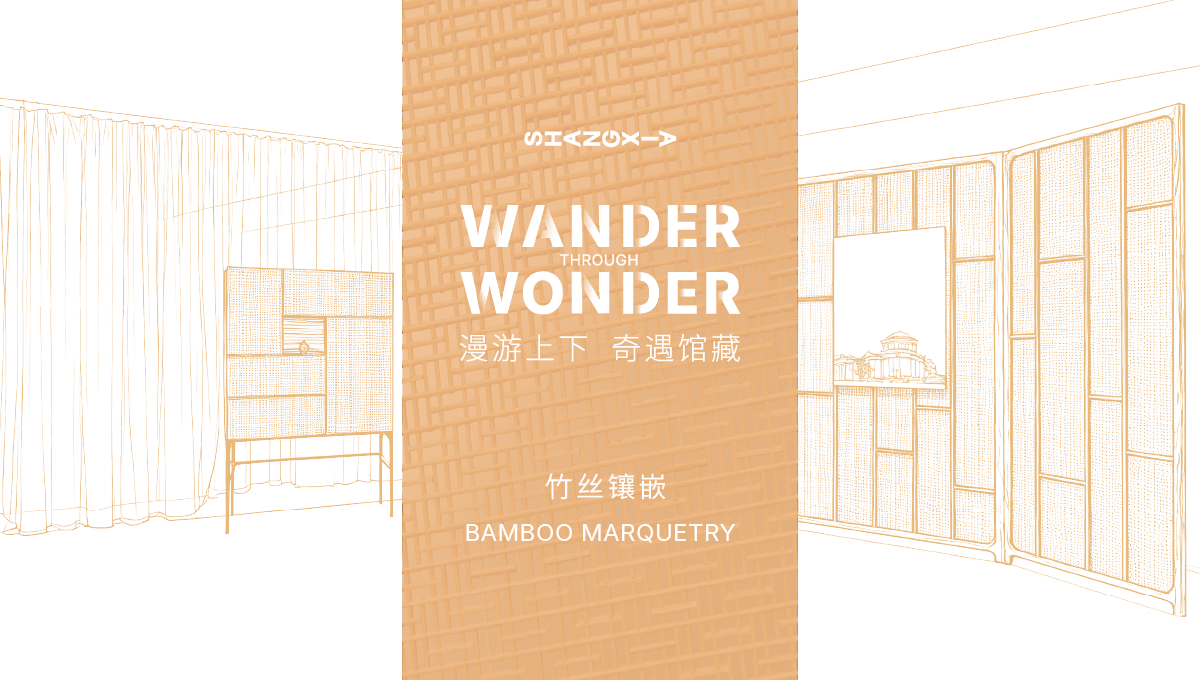
Inlayed into Beams of Light
A Qing Dynasty courtly craft, enduring and ever-renewed. With tweezers as the brush, short bamboo strands become strokes of ink. Patiently inlaid, piece by piece, they merge into form—continuing the luminous legacy of intangible cultural heritage.
探索更多
Layered Waves of Time
Having weathered rises and falls across millennia of history. Lacquer is an artistic collaboration between human hands and time. Awaiting collective polishing by many hands, uncover the brilliance sealed within its layered depths.
Learn More